Home · Solutions · Operationalising AI
Operationalising AI by Eigenstate

Making AI safe, practical and commercially valuable

AI adoption is already happening in most businesses, often without clear oversight, policies or an understanding of the risks. Operationalising AI is our AI readiness consulting service in Harare, built to change that.

  • 01Governance
  • 02Security
  • 03Policy
  • 04Quick, low-risk wins
In short

What is Operationalising AI?

Our Operationalising AI service helps businesses move from informal AI experimentation to structured, responsible adoption. We assess your current AI usage and organisational readiness, establish practical governance, security and responsible-use policies, and identify opportunities where AI can deliver measurable business value.

The outcome: a clear, practical roadmap that protects your business, gives your people confidence and prioritises achievable AI opportunities with tangible commercial benefits.

Service
Operationalising AI: business AI readiness consulting
Provider
Eigenstate Systems, Harare, Zimbabwe
Covers
Governance, security, policy and quick, low-risk wins
For
Organisations of any size in Zimbabwe and across Africa
Led by
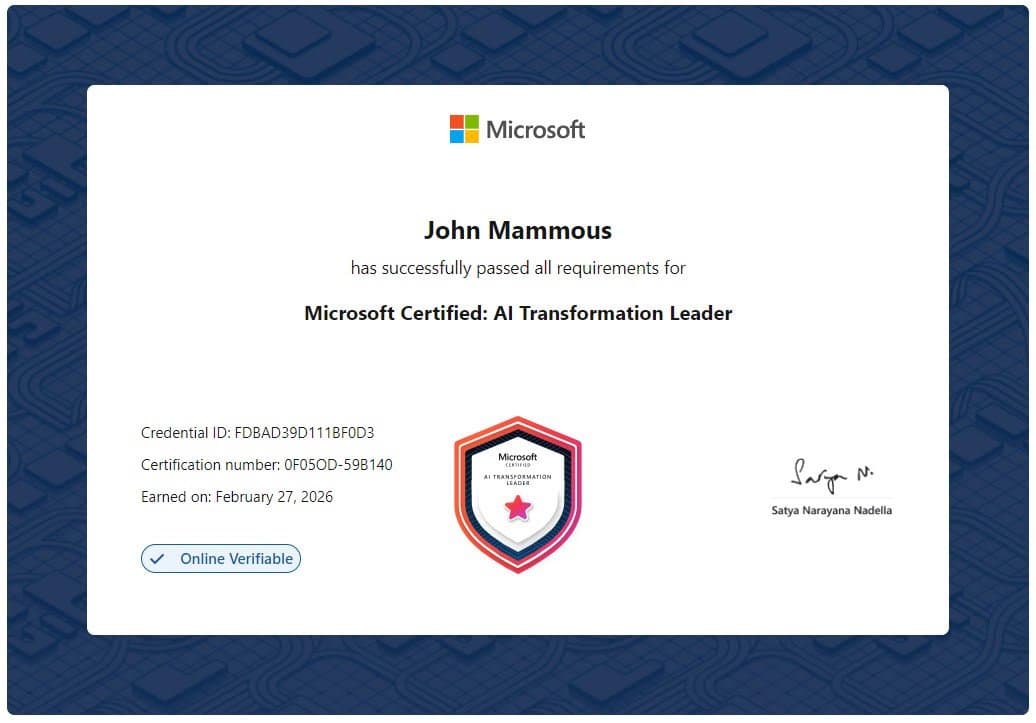
John Mammous, Microsoft Certified AI Transformation Leader
Outcome
A practical AI roadmap with prioritised, achievable opportunities
Format
In person in Harare, or online
The starting point

Your team is already using AI

Free AI tools are on every phone. Without a plan, company and customer information can leave the business with nobody deciding whether it should. Readiness is how you keep the benefit and lose the risk.

Signs you need this now

  • Staff use ChatGPT or similar tools on personal accounts
  • Nobody is formally responsible for how AI is used
  • There is no written guidance on what data may go into AI
  • Leadership wants to use AI but does not know where to start
  • Customers, clients or a board have started asking about your AI use
  • You are unsure how AI fits the Cyber and Data Protection Act
What we cover

Four pillars of AI readiness

Each pillar answers one plain question about how AI is used in your business. Together they turn scattered experiments into practice you can defend.

01

Governance

Who decides, and who is accountable.

Governance is the set of decisions about who owns AI in the business. We help you name an accountable owner, agree how a new AI tool or use case gets approved, and decide which decisions must always stay with a person. It is written to fit the size of your organisation. A family-run business needs a short, clear set of rules; a regulated institution or a group with several companies needs more structure and a record that stands up when questioned.

  • A named, accountable owner for AI
  • An approval route for new tools and use cases
  • Decisions that must always stay with a person
  • Structure scaled to the size of the organisation
02

Security

Where your data goes, and who can see it.

The most common AI risk is ordinary: a staff member pastes a customer list, a contract or a payroll file into a free tool. We review which AI tools are in use, what data reaches them, where that data is stored, whether it may be used to train someone else's model, and who has access. Then we recommend practical controls, such as approved business accounts, access rules and what must never leave your environment.

  • Which AI tools are in use, and on which accounts
  • What data reaches them and where it is stored
  • Whether a provider may keep or train on your data
  • Practical controls for access and approved tools
03

Policy

Rules your staff can actually follow.

An AI policy only works if people read it. We draft a plain-language policy with your team: what staff may use AI for, what they may not, how customer and employee information is handled, when AI use must be disclosed, and how output is checked before it is relied on. We also map your AI use against the Cyber and Data Protection Act [Chapter 12:07] so that you can take it to your lawyer with the right questions. We are engineers, not lawyers, and this is not legal advice.

  • Plain-language acceptable use for staff
  • Clear rules for customer and employee data
  • When AI use must be disclosed
  • How output is checked before it is relied on
04

Quick, low-risk wins

Useful work, not a shelf document.

Readiness should end in useful work, not a shelf document. We look for tasks where AI helps, the data is not sensitive and a person still reviews the result: first drafts of routine documents, summarising long reports and meeting notes, answering internal questions from your own procedures, or cleaning up repetitive admin. You leave with a short, ranked list of what to try first, what to leave for later and what to avoid.

  • Tasks where AI helps and data is not sensitive
  • A person still reviews every result
  • Ranked: what to try first, later, or avoid
  • A plan leadership can act on
The difference

Ad-hoc AI versus operationalised AI

Ad-hoc AIOperationalised AI
OwnershipNobody, or everybodyA named, accountable owner
ToolsWhatever staff findApproved tools on business accounts
DataPasted in without a second thoughtClear lines on what may never leave
OutputTrusted because it sounds confidentChecked by a person before use
CustomersMay not know AI is involvedTold when they deal with automation
Starting pointLarge, risky experimentsSmall, reviewed wins worth repeating
Change management

Start with the problem, not the technology

Businesses often ask how AI can help them. The better question is which problems need solving. Most failed AI projects do not fail on the technology; they fail on change management, because staff feel threatened and expectations are set wrongly. We help you map the AI journey, set up an AI Centre of Excellence (a small group of internal champions and leaders who own adoption), and manage expectations from the board to the front line, so that deployment has a far better chance of success.

  • Map the AI journey around real business problems
  • Set up an AI Centre of Excellence of internal champions and leaders
  • Manage expectations from the board to the front line
Deliverables

What you leave with

Practical outputs you keep and own, whether or not you work with us afterwards.

01

AI use review

A clear picture of which AI tools your people already use, for what, and with which data.

02

Governance model

A named owner, an approval route for new tools and use cases, and a list of decisions that stay with people.

03

Security recommendations

Practical controls for approved tools, access and the data that must stay inside the business.

04

Plain-language AI policy

A staff policy written with your team, covering acceptable use, data handling, disclosure and checking output.

05

Ranked quick wins

A short list of low-risk places to start, with what to leave for later and what to avoid. Delivered as a practical roadmap leadership can act on.

06

AI Centre of Excellence

A small internal group of champions and leaders, set up to own AI adoption, share what works and bring staff along.

How it works

From scattered use to managed practice

  1. 01

    Discover

    We speak to leadership and the people doing the work, and review the tools, data and systems in use, including the AI nobody has formally approved.

  2. 02

    Assess

    We look at governance, security, policy and data handling, and identify where the real risks and the real opportunities sit for your business.

  3. 03

    Put the rules in place

    We agree ownership, draft the AI policy with your team and set out the controls that should apply to approved tools.

  4. 04

    Start safely

    We hand over a ranked list of quick, low-risk wins and a plan for leadership, so that the first use of AI is deliberate, reviewed and worth repeating.

Who it is for

Built for organisations of every size

A family business needs a few clear rules and a sensible place to start. A regulated institution needs formal governance and a record that stands up when questioned. We scale the work to fit.

Why Eigenstate

Beyond policy and recommendations

Our approach is led by a Microsoft Certified AI Transformation Leader with hands-on AI engineering and solution architecture experience, so it goes beyond policy and recommendations. We understand how AI works, how it integrates with existing business systems, and what it takes to implement it reliably. Eigenstate Systems builds and runs AI in production, including the Front Door WhatsApp concierge at Harris Auto, and is a Microsoft Partner and independent software vendor. If you want to build something afterwards, we can. You are under no obligation to use us for it.

See how we handle data, security and AI governance →

Microsoft Certified: AI Transformation Leader certificate held by John Mammous, AI practice lead at Eigenstate Systems
Microsoft Certified: AI Transformation Leader
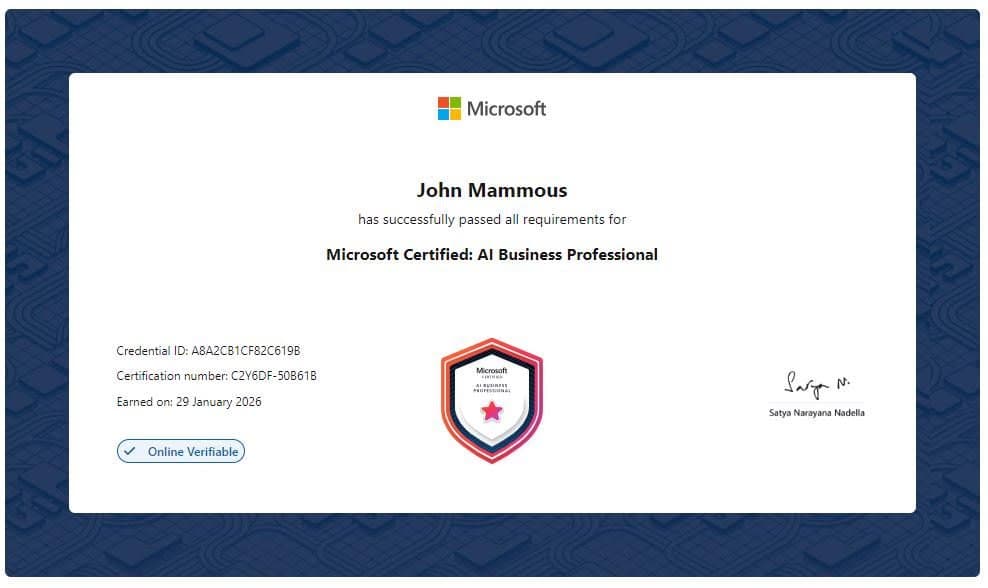
Microsoft Certified: AI Business Professional certificate held by John Mammous, AI practice lead at Eigenstate Systems
Microsoft Certified: AI Business Professional
FAQ

Questions about AI readiness

What is an AI readiness assessment?

It is a structured review of whether a business can use AI safely and usefully. It looks at who is accountable, what data is involved, which tools are in use, what rules exist and where AI could help first. Ours ends in practical outputs: an AI policy, governance decisions, security recommendations and a list of low-risk wins.

Do we need an AI policy if we have not adopted AI?

Usually, yes. Many staff already use free AI tools on their own phones and laptops, so the business can be exposed before it has decided anything. A short policy sets out what is allowed and protects both the company and its people.

Why do AI projects fail?

Usually not because of the technology. The common causes are change management problems: staff who feel threatened, unclear ownership and unrealistic expectations. That is why we start with the problems the business needs solving, set up internal champions through an AI Centre of Excellence, and manage expectations at every level.

Is this only for large companies?

No. The work is scaled to the organisation. A smaller business needs a few clear rules and a sensible place to start. A bank, insurer or group of companies needs more formal governance and evidence.

Does this cover the Cyber and Data Protection Act?

We map how AI touches personal data and identify questions under the Act [Chapter 12:07], which is useful preparation for your legal adviser. We do not give legal advice, so a lawyer should confirm what applies to your business.

Do we have to buy software from you afterwards?

No. Operationalising AI stands on its own. You keep the policy and recommendations, and you can carry them out yourselves, with another provider or with us.

How do we start?

Book a 15-minute briefing. Tell us what you are worried about or what you want AI to do, and we will explain how the engagement would work for your business.

Platform briefing

Book an AI readiness briefing

A 15-minute discussion about where AI could help your business and where it could hurt it. Email sales@eigenstatesystems.com or message us on WhatsApp at +263 77 636 6999.

sales@eigenstatesystems.com · +263 77 636 6999 · Harare